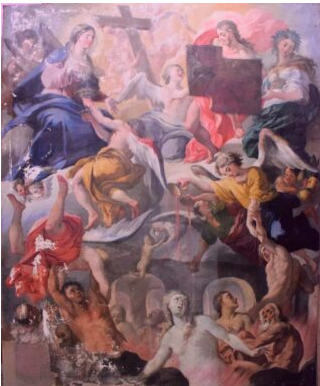
Its activity goes from 1694 to 1753, and is characterized by the works painted in the convents, monasteries, churches of Salerno and Avellino. In the inventories of the works of art preserved in the suppressed churches, convents and monasteries of Salerno, ordered by the Royal Decree of 30 April 1807, he is reported with the name of Abbot Angelo Michele Ricciardi.
In Baronissi in 1699 Ricciardi devoted himself to allegorical figures in the segments of the vault above the church entrance portal. The first of the eight Beatitudes, with the inscription “Beati qui esuriunt et sitiunt iustitiam”, bears the date and the monogram. Ricciardi studied the works of Solimena in nearby Solofra, Nocera Inferiore, in the cathedral of Salerno, in the church of San Giorgio in Salerno, in Naples in the Gesù Nuovo and in the church of Donnaregina Nuova; in the convent of Baronissi the presence of the artist is documented until 1731. The frescoes in the cloister of the convent of Serino date from 1709; at the same time as these frescoes, Ricciardi returned to work on the frescoes in the choir in the nearby convent of Baronissi.
In 1710 he worked in the church dedicated to San Sossio in Serino and in the church of the Body of Christ; in 1711 he worked in the locality of Sant’Angelo dei Lombardi, in the church of Santa Maria delle Grazie. Influenced by the culture of G. Del Po, in the decoration of the ceiling of the same church dedicated to Saints Bartholomew and Mary, with the canvas entitled The Apotheosis of San Benedetto (1718).
Ricciardi’s business was going to expand: in Penta in the church of Santa Maria delle Grazie (former Conservatory of the Immaculate Conception); in the church dedicated to Sant’Andrea in Antessano; in Fisciano in the Carmelite monastery; in Calvanico in the church of the Santissimo Salvatore; in the church of Santa Maria d’Avigliano near Campagna. Also in Campagna, Maurizio Ulino reports in a publication of his three other canvases placed in the ceiling of the church of SS. Salvatore: the Miracle of St. Antonino, which frees a possessed woman tied to the column; the Madonna delle Grazie and saints; the Transfiguration. The fifteen small canvases of the Mysteries of the Rosary are attributed to Ricciardi, in the church of San Domenico in the locality of Acquamela di Baronissi, and the frescoes with the fasting of Christ and the Last Supper, in the refectory of the suppressed convent of the Capuchins in Fisciano (today owned of the De Falco heirs).
In 1731 Ricciardi painted the Battle of Ponte Milvio and the Exaltation of the Cross in the church of Santa Croce di Spiano. In 1739 he was again in his native Penta, in the church dedicated to Saints Bartolomeo and Guglielmo (mistakenly M. t: Penta identifies San Bernardo in place of San Guglielmo), and again in Mercogliano in 1743 in the Congregation of the Immaculate Conception.
Many of his frescoes can be admired in the Convent of the Holy Trinity in Baronissi. Valuable are those of the church choir of the same complex autographed and dated 1708 and 1709 those of the upper part of the transept, later, with the Glory of the Franciscan Order on one side and Dominican on the other, also signed and dated 1721 and those of the entrance with representations of the eight Beatitudes, signed and dated 1699. Also noteworthy are those in the upper part of the church nave depicting allegories of Penance, Justice, Religion, Faith, Fortress, some of which are very deteriorated. It is precisely in the latter that the advance of the rocailles taste, brought to the province thanks to this painter, is more openly manifested. Also in the refectory of the same convent another fresco by Ricciardi representing the wedding at Cana bears the date 1723, as in the cloister, where you can admire the frescoes of two lunettes, depicting the Immaculate Conception and the martyrdom of PP. Felice de Felice, Giuseppe d’Atina and Antonio de Martino occurred in Suakin, Ethiopia, in 1648, and a series of medallions of Franciscan martyrs. He is the author of the frescoes in the cloister of the Monastero del Monte in Montella.

